Jul. 17, 2026
News
1000L Brewing Equipment: Complete Guide for Commercial Breweries
The 1000L brewing equipment sits at a sweet spot for growing breweries. It’s large enough to support regional distribution, yet compact enough that brewers can still maintain direct control over wort quality.The difference between a good 1000L system and a frustrating one comes down to a handful of engineering choices—vessel configuration, heating method, oxygen management, and automation. HGMC’s 1000L system addresses each of those choices with specific design decisions that are worth examining before you sign a purchase order.

What Makes 1000L Brewing Equipment More Than a Bigger Kettle
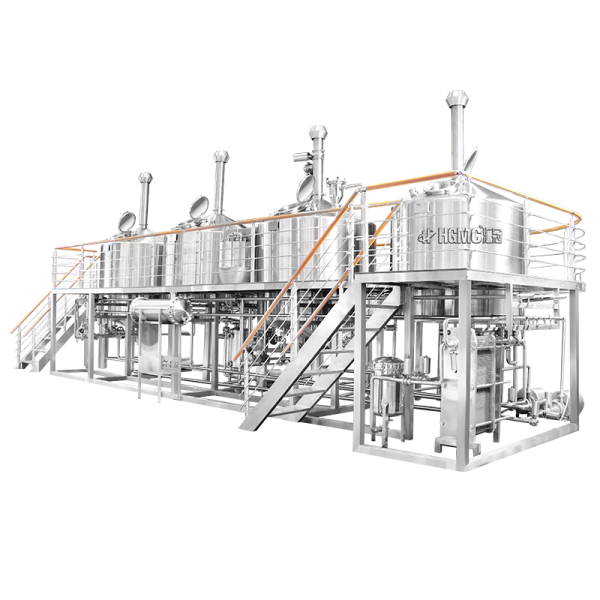
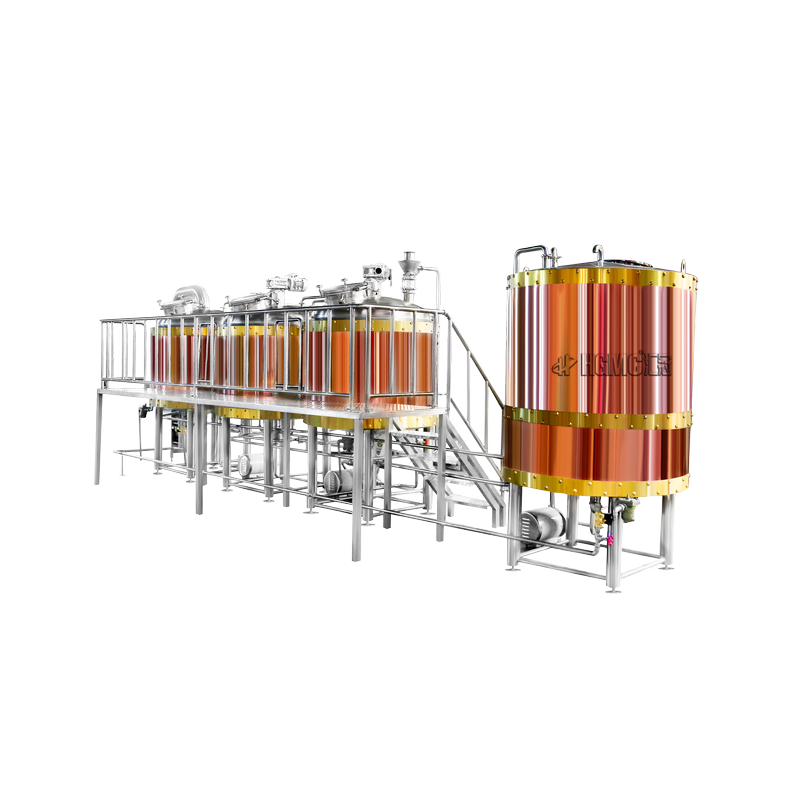
A brewhouse is not a collection of tanks; it is an integrated system where each vessel must work in sequence without becoming a bottleneck. The three-vessel configuration—mash/lauter tun, brew kettle, and whirlpool tank is widely used in 1000L brewing equipment because it enables simultaneous processing. While one batch is boiling, the mash tun can already be mashed in for the next, effectively cutting brew-day time nearly in half compared to single-vessel operations.
The mash/lauter tun handles both mashing and lautering. In well-designed 1000L brewing equipment, maintaining temperature within a narrow range during conversion is essential for consistent wort quality. HGMC’s design helps achieve stable temperature control, while the false bottom is built to minimise stuck mashes. The brew kettle uses a steam-heated jacketed heater, which we will discuss in the next section. The whirlpool tank spins the finished wort to separate trub and coagulated proteins, delivering clearer wort to the fermenter.
For smaller brewhouses or breweries constrained by floor space, HGMC also offers a combi-unit that integrates multiple functions into a single vessel. The tradeoff is clear: a three-vessel configuration requires more installation space than a combi-unit, but it allows true parallel processing. If you are running two batches per day on a regular basis, the additional floor space can be justified by the increase in production efficiency.
The interior finish of every vessel is polished to a mirror surface between 0.2 and 0.4 micrometres Ra. This is not cosmetic. A surface below 0.5 μm discourages biofilm formation and reduces clean-in-place (CIP) cycles from four hours to under three in production environments. Rock-wool insulation wraps each vessel, keeping the exterior temperature low enough to touch safely while cutting energy loss during rests and boils.
The 1000L brewing equipment is designed as a closed loop, but the real differentiation lies in how HGMC addresses two perennial brewing challenges: scorched wort caused by direct heating and oxygen pickup during the mash.
Steam Heating and Anti-Oxidation – Where HGMC Breaks with Older Designs
Direct-fire kettles are still common in smaller systems, but they come with a chronic risk: hot spots on the kettle floor can scorch wort solids, producing burnt off-flavours that no amount of hops can mask. Steam heating helps eliminate this risk by providing more uniform temperature control.HGMC’s jacketed heater circulates steam around a stainless steel jacket, delivering uniform heat across the entire heating surface. The boil is vigorous but gentle—no flame impingement, no localised overheating.
The tangible outcome is a cleaner malt profile. Brewers who move from direct-fire to steam-heated systems often report that their pale ales and lagers taste brighter, with fewer caramelised notes in the finish. Steam heating also improves hop utilisation because the boil drives off volatile compounds more gently. Delicate aroma hops that would normally lose their character in an aggressive direct-fire boil retain more of their essential oils, creating a noticeable difference when comparing a single-hop IPA made on each system.
Oxygen management is the second major differentiator. Most brewhouses introduce oxygen during the mash and sparge through vortexing—the spinning motion created by conventional stirring paddles draws air into the liquid. HGMC’s anti-oxidation stirring paddles operate at low speed and are designed to create minimal vortex. The double-layer stirring mechanism moves the mash horizontally rather than vertically, keeping oxygen uptake to a minimum during the critical period when enzymatic conversion is still active.
Oxidation in the brewhouse manifests weeks later as stale beer with a cardboard-like aroma. Brewers who have chased this issue downstream often overlook its origin: the damage was done before the wort ever reached the fermenter. By controlling oxygen pickup at the mash stage, HGMC’s 1000L brewing equipment helps protect hop aromas and extends shelf stability without requiring expensive inert gas blanketing in the kettle.
The steam system also includes a secondary steam atomisation and condensation unit that captures vapour from the boil, condenses it, and routes it away from the brewhouse atmosphere. This keeps the working environment cooler and reduces energy loss, but the operational benefit that brewers notice most is the absence of steam fog that obscures sight glasses and coats overhead surfaces with condensation.
Automation and Repeatability: How 1000L Brewhouse Equipment Improves Brewing Consistency
A 1000L brewing equipment system that relies entirely on manual control demands a seasoned brewer on every shift. As production scales, that becomes a bottleneck. HGMC integrates a Programmable Logic Controller (PLC) that manages temperature ramps, hold times, pump sequences, and whirlpool durations across the entire brew cycle.
The PLC stores multiple recipes and allows the brewer to program step-by-step profiles for different styles. A Pilsner profile with a protein rest at 50°C, a thick mash at 63°C, and a final mash-out at 78°C can be saved and recalled with a single selection. The same profile, executed by different operators on different days, will produce wort with original gravity within 0.5°P variation. That consistency matters when you are selling contract-brewed beer or maintaining a core lineup that your distributors rely on.
From the central control interface, the brewer can monitor temperatures in each vessel, pump flow rates, and the status of the steam heating without walking the floor. The system logs data automatically, which simplifies batch recording and traceability for regulatory audits.
The secondary steam atomisation and condensation unit we mentioned earlier is also controlled through the PLC. During the boil, the unit activates automatically when the vapour temperature exceeds a set point, condensing steam and redirecting it to the drain. This reduces water usage compared with open venting systems and helps keep the brewery environment cleaner and more efficient.
Automation does come with an upfront cost premium, but for a 1000L brewing equipment system running two batches per day, the labour savings typically offset the investment within twelve months. The operator no longer needs to stand over the mash tun and stir by hand. The PLC handles the repetitive parts, and the brewer spends that time on recipe development, yeast management, or quality control.
Choosing 1000L Brewing Equipment: What to Check Before You Buy
Before ordering any 1000L brewhouse, brewers should evaluate several critical factors that distinguish well-engineered systems from equipment that may create operational issues after installation.
Vessel construction. Confirm that the interior surface finish is documented at 0.2–0.4 μm Ra. Suppliers that cannot provide documented surface roughness measurements may not have the same level of control over finishing quality. Check weld transitions. Internal welds should be ground flush and passivated; a rough weld seam can become a potential area for bacterial buildup that is difficult to remove through normal CIP procedures.
Insulation thickness. For commercial brewing systems, rock-wool insulation is typically specified at around 50 mm for the kettle and 30 mm for the mash tun. Thinner insulation means higher energy bills and a hotter work environment, especially in summer.
Heating method. If the budget allows, steam heating should be the default for any system above 500 litres. Direct-fire may reduce the initial investment, but it can increase the risk of wort scorching and require more attention during operation.
Oxygen control. Ask whether the stirring mechanism includes anti-vortex features. Many budget brewhouses use standard impeller paddles that create a visible vortex during mashing. That vortex is pulling oxygen into your wort, and you will pay for it later in reduced shelf life.
Control interface. Spend an hour on the PLC interface before signing. Is the screen responsive? Are the menus organised logically? A poorly designed interface will frustrate operators and introduce errors. HGMC’s PLC is built on standard industrial hardware, and the HMI screen is configurable without specialised programming knowledge.
The 1000L system from HGMC is designed for breweries that have outgrown the nano stage and are entering regional distribution. At this production level—roughly 1,000 litres per batch, with two batches per day—the 1000L brewing equipment can support annual output of 600–700 hectolitres, which is enough to serve multiple taproom accounts and a modest wholesale footprint. The engineering choices described in this article are not theoretical. They show up in the glass.
FAQ
What is the typical brew-day output for a 1000L system?
With a three-vessel configuration and simultaneous processing, a well-practised team can complete two batches of 1,000 litres in a single shift. A single batch including mash-in, boil, and whirlpool typically takes 5–6 hours from grain-in to knockout.
How long does it take to install a 1000L brewhouse?
Installation usually requires 3–5 working days, provided the brewery has the necessary electrical and steam connections in place. A qualified commissioning engineer should verify the PLC, heating system, pumps, and safety functions before handover.
Does the 1000L equipment require special electrical or plumbing work?
Steam-heated systems require a boiler connection or an electric steam generator. Electrical needs depend on the pump and control panel power, typically 380V three-phase for industrial setups. A standard water line with a backflow preventer is sufficient.
Can the PLC system integrate with brewery management software?
HGMC’s PLC can export batch logs via Modbus or TCP/IP. Most commercial brewery management platforms (like Ekos, Beer30, or OrchestratedBEER) can ingest these logs for inventory tracking and costing, though integration setup varies.
What maintenance does the steam heating system require?
The steam side needs periodic checks for gasket integrity on the jacketed heater and condensate trap replacement. The rock-wool insulation should be inspected for moisture ingress. CIP cycles on the kettle interior remain the same regardless of heating method.