Jul. 07, 2026
News
5000L Brewing Equipment for Serious Breweries
5000L brewing equipment: when does it make sense?
5000L brewing equipment is designed for breweries that are ready to move beyond small, local volumes into stable regional or national supply. At roughly 50 hl per batch, a 5000L brewhouse can support multiple flagship beers, regular seasonal releases, and long‑term contracts with bars, distributors, and retailers. It is a scale that requires careful planning: the investment is significant, but the payoff can be strong when demand is clear.For this stage, choosing a system is not just about buying bigger tanks. It is about designing a complete brewing line that fits your building, your utilities, your team, and your market strategy. HGMC focuses on 5000L solutions as integrated projects, combining brewhouse, fermentation cellar, cleaning systems, and controls so production remains consistent and efficient.
What is included in a 5000L brewing system?
A typical 5000L brewing equipment package covers the entire process from mash‑in to bright beer. While every project is customized, most systems will include:- Brewhouse vessels
- Fermentation tanks
- Bright beer tanks
- Cooling system
- CIP (clean‑in‑place) system
- Pumps, valves, and piping
- Control system
When HGMC designs a 5000L setup, all these elements are planned together, so vessel sizes, piping runs, and control logic match your production targets and building layout.
Brewhouse design options at 5000L
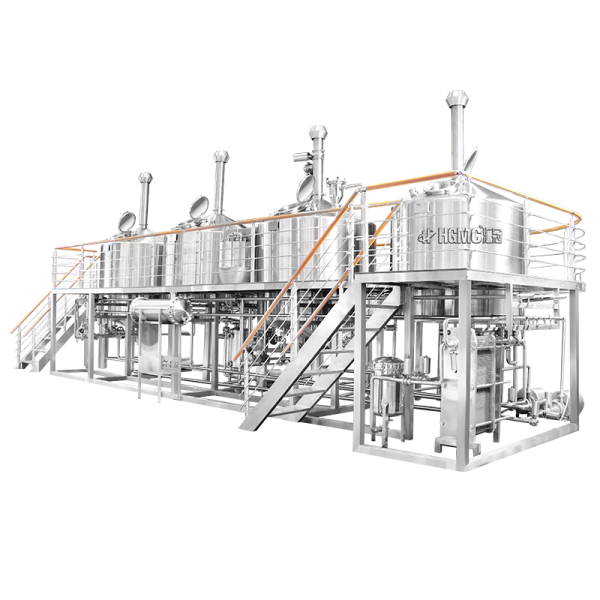
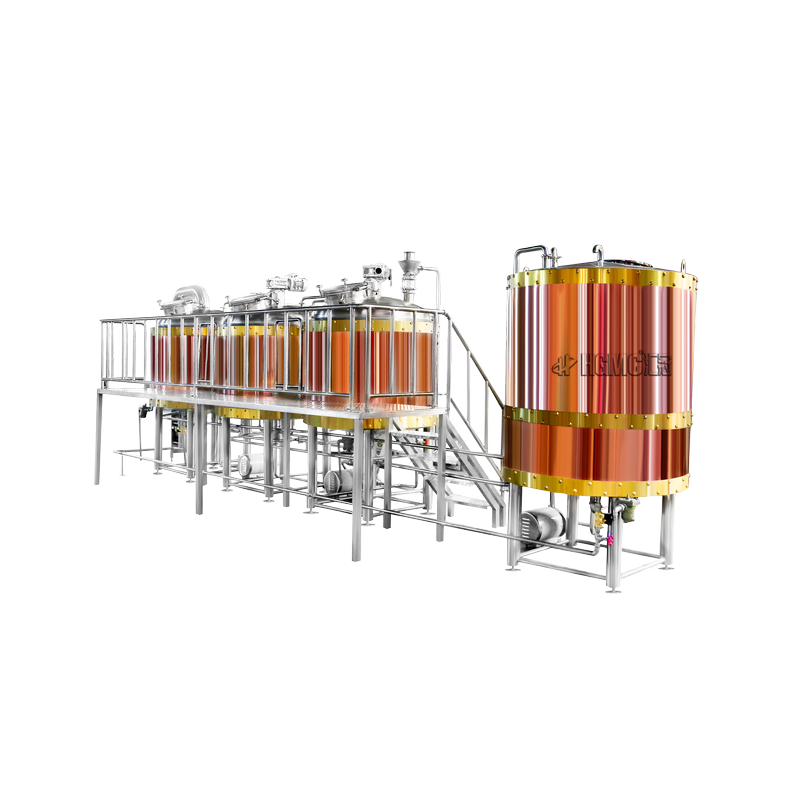
At 5000L capacity, brewhouse design has a direct impact on daily efficiency. Breweries usually choose between two main structures:- 3‑vessel brewhouse Consisting of a mash tun, lauter tun, and a combined kettle/whirlpool.
- Suitable for breweries that aim for a moderate number of brews per day.
- Offers a good balance between investment and throughput.
- Allows partial overlap of steps (for example, mashing while the previous batch boils).
- 4‑vessel brewhouse With separate mash tun, lauter tun, kettle, and whirlpool.
- Designed for higher daily output and more overlapping processes.
- Makes it easier to run multiple brews per day at 5000L.
- Provides clear separation of functions, which can simplify operation and cleaning.
Fermentation and bright beer solutions for 5000L equipment
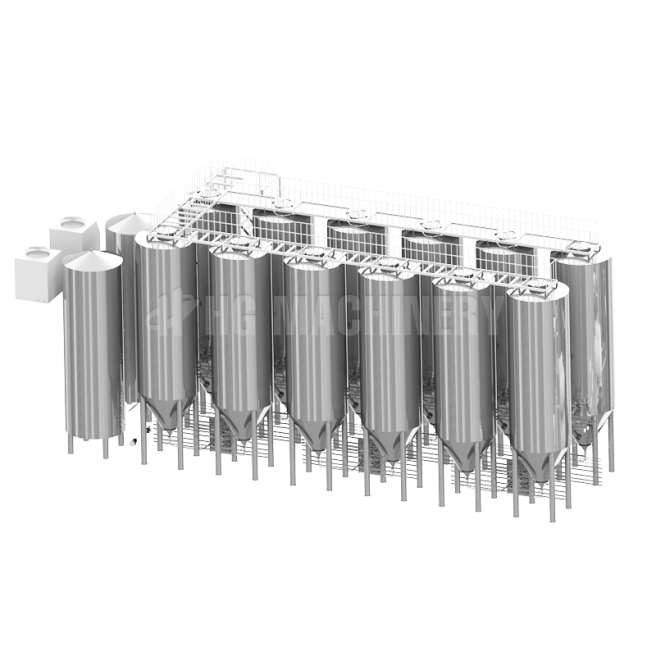
The fermentation cellar must match the power of the brewhouse. For a 5000L system, a typical HGMC design will consider:- Number of fermenters
- Tank volume mix
- Cooling and control
- Bright tank capacity
HGMC lays out tanks to maintain safe access, logical piping routes, and efficient CIP paths. In practice, this means staff can manage sampling, dry hopping, transfers, and cleaning without excessive walking or complex hose arrangements.
Cost factors for 5000L brewing equipment
A 5000L brewing system is a major investment, and several common factors will influence overall cost:- Brewhouse configuration
- Total tank volume
- Material and finishing
- Automation level
- Utilities and CIP
- Customization
HGMC’s role is to help you prioritize. Some features are “nice to have,” while others are essential for safe, stable, and efficient production at 5000L. A clear conversation about your goals and constraints helps build a balanced specification.
How HGMC designs 5000L brewery solutions
HGMC approaches each 5000L project as a full brewery solution. The process usually follows these steps:1.Understanding your plan
You share your target annual volume, core and seasonal beer list, building dimensions, and utility conditions. HGMC uses this information to understand how the brewery should function day‑to‑day.
2.Concept and layout proposal
HGMC suggests a brewhouse configuration, tank numbers, CIP concept, and a draft layout showing where equipment might sit in your space.
3.Technical specification
Together, you refine vessel sizes, material thickness, fittings, platform shapes, and control options. This stage turns ideas into concrete technical descriptions.
4.Quotation and timeline
HGMC prepares a clear equipment list, cost breakdown, and indicative production and delivery schedule, so you can plan finances and construction work.
5.Manufacturing and quality checks
The equipment is fabricated to specification, with inspections and testing before shipment.
6.Installation guidance and start‑up support
While local contractors usually install the equipment, HGMC provides documentation and technical assistance to support commissioning and early brews.
7.Ongoing service
After start‑up, HGMC remains available for spare parts, adjustments, and advice on optimizing your 5000L system as production grows.
This kind of end‑to‑end support gives breweries more confidence as they move into larger volumes.
Is 5000L brewing equipment right for your brewery?
Before committing to a 5000L system, it is helpful to think through a few key questions:- Do you have, or expect soon, enough demand to keep a 5000L brewhouse and cellar working regularly?
- Is your beer portfolio focused enough that large batches make sense, or will you need a mix of tank sizes?
- Does your building provide sufficient space and utility capacity for brewhouse, tanks, platforms, and CIP?
- Is your team ready to handle more complex equipment and potentially higher levels of automation?