Sep. 20, 2026
News
Why Do Stainless Steel Fermentation Tanks Use a Conical Bottom?
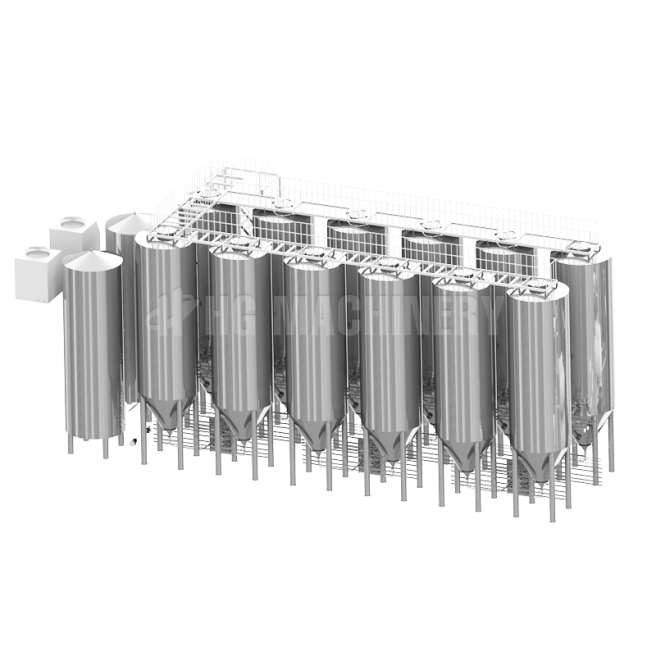
When choosing stainless steel fermentation tanks for beer production, the conical bottom is an important part of the tank design. It is not only about the appearance of the tank. The cone creates a practical collection area for yeast and sediment and makes several fermentation operations easier.
If you are comparing fermentation tank configurations, understanding the role of the cone can help you choose the right tank structure, fittings, and capacity for your brewery. Our stainless steel fermentation tanks are available in different capacities and configurations to match different beer production requirements.
Why Is a Conical Bottom Used in Beer Fermentation Tanks?
The main purpose of a conical bottom is to direct settled material toward the lowest point of the tank.
During beer fermentation, yeast and other solids settle toward the bottom. The sloped cone creates a defined collection area, making these materials easier to manage without unnecessarily disturbing the beer above them.
Yeast Collects at the Lowest Point
The cone guides settled yeast toward the bottom outlet. This makes yeast removal more controlled and provides a practical way to manage sediment during fermentation.Sediment Is Easier to Separate
A conical structure keeps settled material concentrated in one area instead of spreading it across a flat bottom.
This helps brewers remove sediment while keeping the main beer volume in the tank.
How Does a Conical Fermentation Tank Make Beer Handling Easier?
The conical bottom works together with the tank's outlets, valves, and racking system. The exact configuration can be selected according to the brewing process.Racking Above the Sediment
A suitable racking arm or standpipe can help transfer beer while leaving settled material below.
Our fermentation tanks can be equipped with side rotating racking arms or standpipe designs. This gives brewers more flexibility when planning beer transfer and sediment management.
Controlled Discharge
The lowest point of the cone provides a natural location for discharge fittings.
Yeast and sediment can collect around this outlet, making removal more convenient during normal tank operation.
What Makes a Conical Fermentation Tank Practical for a Brewery?
The cone is only one part of a useful fermentation system. Tank capacity and accessories also need to match the production process.
For example, our 1000L fermentation tank has a 1250L gross capacity and a 1000L useful capacity. Its cylindrical-conical structure can be configured with valves, fittings, racking components, pressure equipment, and other accessories according to production requirements.
Useful Tank Configurations
Depending on the application, the tank can include:- Racking arm or standpipe
- Sample valve
- Butterfly valve
- Safety valve
- Venting valve
- Manometer
- Filling level indicator
- Hop port
- CIP arm
How Does the Conical Bottom Work With Temperature and Pressure Control?
A conical bottom is important for yeast and sediment management, but fermentation performance also depends on temperature and pressure control.Temperature Control
Our fermentation tanks can use a double stainless steel jacket with water or glycol cooling. PUR insulation is also available to help maintain the required fermentation temperature.
For the 1000L model, the useful capacity is 1000L, with an 80mm polyurethane insulation layer and a dimple jacket cooling system.
Pressure Management
The tank can also be equipped with an adjustable pressure valve and glycerine manometer for controlled fermentation.
A safety valve provides overpressure and vacuum protection, while a venting valve supports controlled pressure release.
Together, these components make the conical fermentation tank suitable for a more complete beer fermentation process.
What Stainless Steel Finish Is Suitable for Fermentation Tanks?
Material and surface finish are important because fermentation tanks need to support repeated cleaning and sanitation.
Our fermentation tanks use SUS304 stainless steel. The internal surface roughness can be specified at Ra < 0.8 μm for ground surfaces or Ra < 0.5 μm for polished surfaces, depending on the required finish.
CIP Cleaning
The tanks can use CIP in-situ cleaning with a rotary spray cleaning ball.
This allows cleaning to be integrated into the tank configuration and reduces the need for manual cleaning access during routine operations.
Tank Access
A service door can be positioned on the top cone or cylinder section according to the tank configuration.
This provides practical access for inspection and maintenance while keeping the tank suitable for regular brewery operation.
How Should You Choose the Right Conical Fermentation Tank?
The right tank depends on more than the cone design. Production capacity, installation space, fermentation requirements, cooling, pressure control, and fittings should all be considered together.Match Capacity With Production
Our fermentation tank range includes 300L, 500L, 1000L, 1500L, and 2000L models, along with larger-capacity options.
For example, the 300L model has a 375L gross capacity and 300L useful capacity, while the 500L model has a 670L gross capacity and 500L useful capacity.
Choosing according to useful capacity helps ensure that the tank fits the planned brewing schedule.
Check Installation Dimensions
Tank dimensions should be confirmed before finalizing the configuration.
The 1000L model has a diameter of 1360mm and a height of 2500mm. These dimensions need to be considered together with access space, piping, cooling connections, and maintenance requirements.
Select the Right Cone Configuration
Cone angles can be changed according to customer requirements.
This allows us to adapt the tank structure to the intended brewing process and installation conditions rather than using the same configuration for every brewery.
Why Choose HGMC for Stainless Steel Fermentation Tanks?
We provide beer brewing equipment for different production scales, from individual fermentation tanks to complete brewery projects. Our equipment can be configured according to production capacity, fermentation requirements, installation conditions, and process needs.
Our approach is to discuss the actual requirements first and then determine the appropriate tank capacity, cooling system, pressure components, fittings, and other configurations. More information about our capabilities and brewing equipment solutions is available through About HGMC.
If you are planning a new brewery, expanding fermentation capacity, or replacing existing tanks, we can help you determine a suitable configuration based on your production requirements.
Instead of choosing a tank based only on volume, tell us your target capacity, brewing process, and installation requirements. We can then discuss the appropriate fermentation tank configuration and provide a quotation for your project.
For tank specifications, customization requirements, and pricing, contact HGMC directly. We will review your requirements and provide suitable equipment information and a project quotation.
HGMC focuses on beer brewing equipment and practical solutions for breweries of different production scales. From conical fermentation tanks to complete brewing systems, we aim to provide equipment that fits the actual requirements of each beer production project.