May. 25, 2026
News
The Silent Performer – Why Fermentation Temperature Control Defines Your Beer’s Ceiling
Ask any seasoned brewmaster: the difference between a good beer and an unforgettable one is often just two degrees Celsius. Fermentation is not merely a biological process—it is a thermodynamic symphony. And the conductor is your temperature control infrastructure.
Yeast strains respond to thermal environments with dramatic sensitivity. A lager fermented at 10°C instead of 12°C produces a cleaner, crisper profile but risks a sluggish finish. An ale allowed to drift from 18°C to 22°C during peak activity can generate unwanted fusel alcohols, turning a juicy IPA into a solvent-like disappointment. Precision cooling is not optional; it is the invisible backbone of flavor reproducibility.
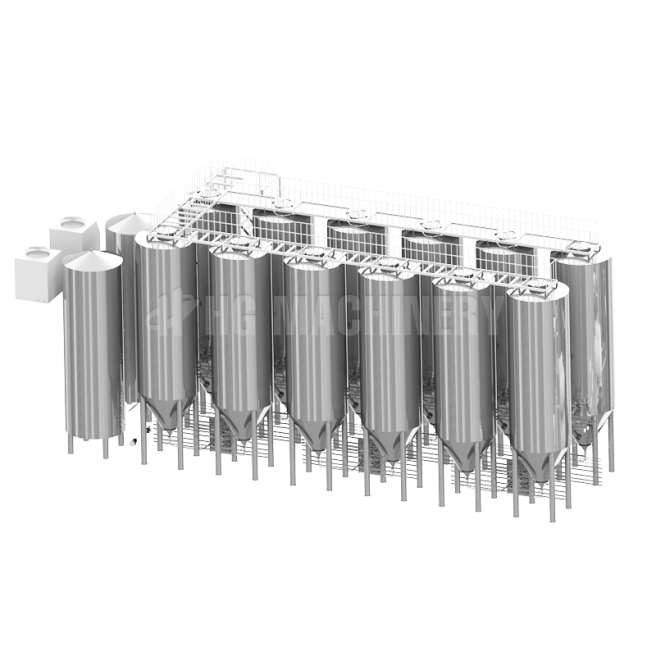
For the plant engineer, this means looking beyond simple glycol chillers. The true differentiator is zone control. Advanced fermentation vessels feature independently jacketed cone, sidewall, and upper zones. During active fermentation, the core zone pulls heat away from the exothermic center while the cone remains slightly warmer to encourage healthy yeast flocculation. At crashing time, all zones work together to drop temperature uniformly, preventing thermal shock that could crack yeast cell walls and release off-flavors.
For the brewery owner, energy efficiency is equally critical. A glycol system with variable-speed compressors and insulated supply lines can reduce cooling electricity consumption by up to 35% compared to fixed-speed alternatives. When applied across ten fermenters running sequential schedules, the annual savings often exceed the cost of a new bright tank.

But what about brewpubs or small nano breweries with limited mechanical space? Modern compact glycol units integrate direct expansion coils into each tank, eliminating bulky central chillers. These “self-contained” fermenters require only a standard electrical outlet and a hose for condenser water. They fit into corners, closets, or even outdoor enclosures with weatherproofing.
Brewmasters should also demand recording capabilities. A fermentation tank without data logging is a recipe for guesswork. Look for systems that store temperature and pressure curves for each batch, ideally exportable to cloud spreadsheets. When a customer complains about batch variation, you can trace the thermal history in minutes, not months.
Finally, never underestimate the value of separate glycol zoning for cold crashing vs. dry hopping. During dry hop addition, you may want to warm the tank slightly to encourage hop oil dissolution, then crash aggressively. The best systems let you program such sequences in advance, turning a fiddly manual operation into a set-and-forget schedule.
Does your current fermentation lineup offer true zone independence? Share your typical fermentation cycle and target beer styles. We will recommend a tank and glycol configuration that protects every batch’s potential.